
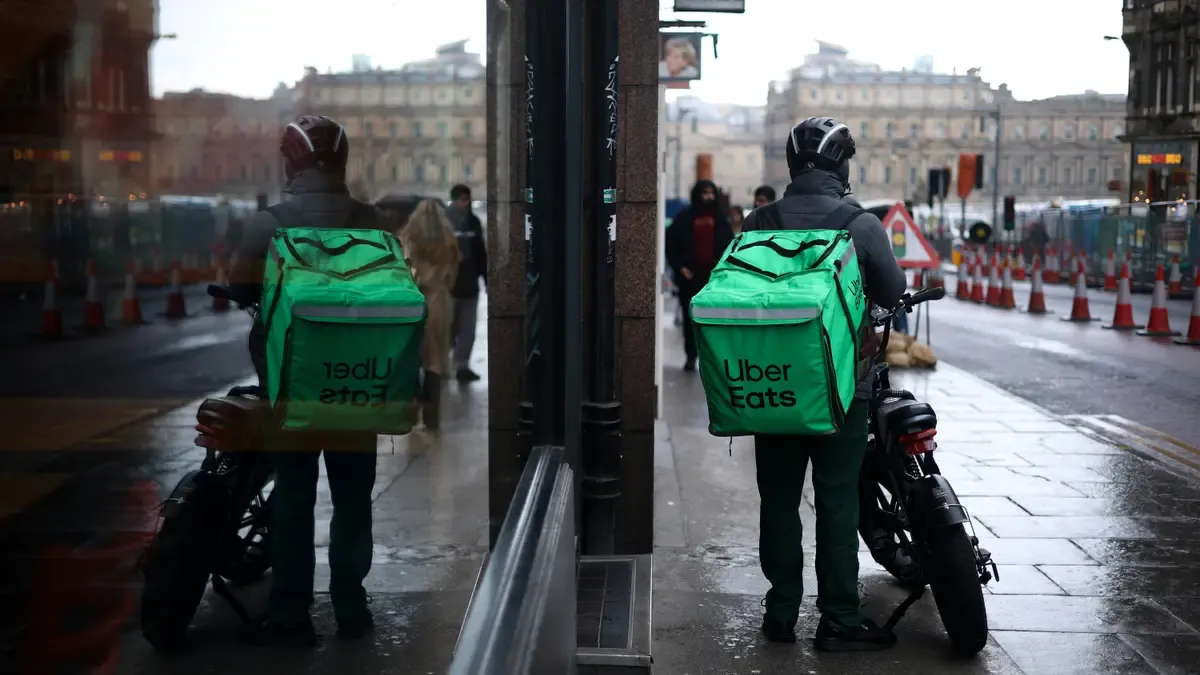
Driving for Uber Eats is worth it if you can work the lunch and dinner peaks in a busy part of town: most drivers keep somewhere between £6 and £11 an hour once Uber's fee and their running costs are paid. That is self-employed revenue, not a wage, and no minimum wage sits under a quiet shift. So it is a poor fit if you need a fixed weekly income.
But accessible does not mean straightforward. Before you sign up, you need to know how the pay actually works and whether the hourly rate holds up once Uber takes its cut.
This guide covers all of it: the real earnings by vehicle type, what you need to start, insurance you cannot skip, and how experienced drivers stack their income across multiple platforms.
How driving for Uber Eats works in the UK
Uber Eats drivers are self-employed contractors. You work when you choose, accept or decline deliveries freely, and receive payment based on what you complete, not the hours you are online.
You download the Uber Driver app, go online in your area, and delivery requests appear on your screen. Accept one and the app guides you to the restaurant, then to the customer.
The three components of every delivery payment
Each delivery is made up of three separate fees, combined automatically in the app:
- Pick-up fee, paid once per restaurant visit
- Per-mile rate, calculated from the restaurant to the drop-off point
- Drop-off fee, paid per order completed
Uber does not publish these rates publicly. In practice, the minimum fare for a short delivery in London is typically under £3 before extras. Uber then deducts its service charge from your earnings before you receive payment.
Uber Eats versus Uber rideshare: a different earning model entirely
This is the distinction that trips up most new drivers. Uber ride-hailing drivers in the UK have a minimum earnings guarantee and access to Uber Pro's most generous benefits, including pension contributions, holiday pay, and tuition cover on a range of university courses.
Uber Eats delivery drivers have none of that. You are on a pure per-delivery model, with no floor on hourly earnings. That gives you more flexibility but removes the safety net.
What you actually earn driving for Uber Eats
Earnings vary based on your vehicle, location, time of day, and how efficiently you work your area. The headline figure you will see quoted online, typically £7 to £14 per hour, is gross before Uber's service charge and your running costs.
Because this is self-employed work, every figure below is revenue rather than a wage. Fuel, insurance, vehicle wear and a tax reserve come out of it, and no minimum wage underwrites a quiet shift.
Pay by vehicle type: realistic UK figures
| Vehicle | Typical gross per hour | Uber service charge | Running costs | Realistic net per hour |
|---|---|---|---|---|
| Bicycle or e-bike | £9 to £12 | 20% to 25% | Low (maintenance only) | £7 to £10 |
| Moped or scooter | £10 to £14 | 20% to 25% | Medium (fuel, insurance, servicing) | £7 to £11 |
| Car | £10 to £14 | 25% (London) | High (fuel, insurance, maintenance) | £6 to £10 |
Figures are based on OttoCar's 2024 driver research and INSHUR's 2025 pay data, so they are indicative rather than rates Uber publishes. Actual earnings depend on your location, hours worked and order density in your area.
A bicycle courier in a busy city can net more per hour than a car driver, precisely because running costs are far lower: no fuel, no congestion charges, and no comprehensive delivery insurance to fund. For a wider view of what bike-based work pays across the platforms, see our roundup of the best bike delivery jobs.
Boosts, tips and peak hours: where the real uplift comes from
Uber Eats offers additional earning opportunities that go beyond the base delivery rate:
- Tips. 100% yours, with no service fee deducted. Customers can add a tip up to 7 days after delivery.
- Boosts. Surge-style multipliers applied in specific zones during busy periods. Availability varies by city and changes frequently.
- Batched orders. Delivering two or three orders collected from the same restaurant at once. You receive the per-mile rate for each drop-off individually, which improves your earnings per hour significantly.
- Quest bonuses. Complete a set number of deliveries within a defined period and earn a bonus payment. These appear in the promotions section of the app.
Drivers who actively chase peak hours, meaning Friday and Saturday evenings, bad weather days and bank holidays, consistently report higher hourly rates than those working standard daytime shifts.
After expenses: what a realistic week looks like
A car driver completing 40 hours per week across peak and off-peak shifts might gross £480 to £560 before deductions. After Uber's service charge, fuel, and a pro-rated share of annual insurance, take-home is typically in the range of £320 to £400 per week, before any tax reserve.
A bicycle courier working the same hours in a city typically achieves a similar or slightly better net, with significantly lower outgoings.
Uber Eats versus Deliveroo versus Just Eat: which pays more in the UK?
Uber Eats is not the only option. Here is how the four main UK platforms compare.
| Platform | Pay structure | Vehicle | Min. age | Coverage | Typical gross per hour |
|---|---|---|---|---|---|
| Uber Eats | Per delivery (pick-up, mileage, drop-off) | Bicycle, moped, car | 18 bicycle, 19 motorised | Nationwide | £9 to £14 |
| Deliveroo | Per delivery, fee shown upfront, GMB pay floor | Bicycle, moped, car | 18 | Major UK cities | £9 to £13 |
| Just Eat | Per delivery, or employed in some areas | Bicycle, moped, scooter | 18 | Nationwide | £8 to £14 |
| Amazon Flex | Per block (2 to 5 hr fixed shifts) | Car or van required | 18 | Nationwide | £14 to £18 |
No single platform is best for every driver. Uber Eats has the widest coverage and the most established driver base in the UK. Deliveroo pays competitively in city centres. Just Eat offers employed contracts in some areas. Amazon Flex pays well but requires a car and works to a fixed schedule. For the full side-by-side on pay and conditions, see our guide to the best delivery driver jobs in the UK.
Most experienced delivery drivers in the UK do not choose one platform. They run two or three simultaneously and toggle between whichever has active orders in their area. One profile on Service Club ® lets you apply to several of them at once and pick which to run.
Requirements for driving for Uber Eats in the UK
Minimum ages differ by vehicle, and they are set by Uber, not by law. Check Uber's own rider and driver portal before applying, because requirements change and vary by city.
Bicycle or e-bike:
- Minimum age 18
- Photo ID (passport or driving licence)
- Bank statement from within the last 3 months
- Right to work in the UK
Moped or scooter:
- Minimum age 19
- Full UK or EU driving licence, correct category
- Bank statement from within the last 3 months
- Valid MOT
- Insurance covering food delivery work
- Right to work in the UK
Car:
- Minimum age 19
- Full UK or EU driving licence
- Bank statement from within the last 3 months
- DVLA electronic counterpart check code for UK licence holders
- Valid MOT
- Insurance covering food delivery work
- Right to work in the UK
Background check: what it involves and how long it takes
After submitting your documents, Uber triggers a background check through its partner firm Sterling. This covers a basic disclosure and right-to-work verification.
Uber states that new delivery drivers can be active within 24 hours. In practice the process often takes 1 to 2 weeks, depending on how quickly documents are verified and the check is completed. Bicycle couriers typically move through fastest, as the document list is shorter.
What it actually costs to drive for Uber Eats
Uber's service charge and how it affects your take-home
Uber deducts a service charge from every delivery fare before you receive payment. This is not a fee you pay separately: it is subtracted automatically.
- London, car: 25%
- Other cities and vehicle types: typically 20% to 25%
On a £12 delivery fare, Uber's 25% cut leaves you with £9 before your running costs. Factoring this in from the start gives you a much more accurate picture of hourly earnings than the headline rate suggests.
Food delivery insurance: what you need and what it costs
Standard personal vehicle insurance does not cover you while you are earning money from deliveries. This is one of the most important things to get right before your first shift.
For cars and mopeds you need a policy that explicitly covers food delivery work, sometimes referred to as hire and reward for delivery, or class 3 use. Without it, you are uninsured during every delivery.
Uber does not provide this cover. You arrange it separately. Providers in the UK include Zego, INSHUR and Veygo. Costs depend on your vehicle, driving history, and whether you want annual or pay-as-you-go cover. Our delivery driver insurance cost guide has the full breakdown.
Fuel, tax and HMRC: the self-employed obligations
As a self-employed delivery driver, you are responsible for your own tax:
- Register with HMRC at gov.uk/register-for-self-assessment as soon as you start earning
- File a self-assessment tax return each year
- Pay Class 4 National Insurance on profits above £12,570. Mandatory Class 2 National Insurance was removed for the self-employed from April 2024, though you can still pay it voluntarily, at £3.65 a week for 2026/27, if your profits are low and you want to protect your State Pension record
- Keep records of all income and expenses from day one
On the upside, you can claim allowable expenses against your tax bill: fuel, vehicle maintenance, a portion of your phone bill and professional subscriptions. HMRC's Approved Mileage Allowance Payment rate for the 2026 to 2027 tax year is 55p a mile for the first 10,000 business miles in a car and 25p a mile after that, or 24p a mile if you ride a moped or motorcycle.
How to earn more driving for Uber Eats
Peak timing, zone selection and batched orders
The difference between £8 and £12 per hour often comes down to when and where you work, not how many hours you put in.
Experienced drivers focus on two windows: the lunch rush from 11am to 2pm, and the evening peak from 5pm to 9pm on weekdays, extending later on Fridays and Saturdays. Outside those windows, order volume drops sharply in most areas.
Zone selection matters too. Areas with a high density of restaurants and residential housing within a short radius reduce dead mileage between orders. Batching two or three orders from the same restaurant, when the app offers it, is the single most effective way to increase per-hour earnings.
Running multiple delivery platforms at once
Most high-earning food delivery drivers in the UK do not rely on Uber Eats alone. They keep two or three apps open simultaneously and switch to whichever has orders in their area.
Is driving for Uber Eats worth it? The honest answer
It depends entirely on what you are comparing it to and what you need from the work.
Uber Eats works well if:
- You want to work evenings or weekends around another job
- You already own a car, moped or bicycle and the insurance cost is manageable
- You live in or near a city with consistent demand
- You are willing to track your expenses properly and file a tax return
Uber Eats is harder to sustain if:
- You need a predictable weekly income without variable peaks
- Your vehicle running costs are high, with an older car or a high insurance premium
- You are based in a low-density area with limited restaurant coverage
- You are comparing it to Uber ride-hailing, where earnings and protections are substantially higher
The drivers who get the most out of Uber Eats treat it as one income stream among several. Combined with one or two other platforms, the income becomes far more stable and the hourly rate is easier to sustain.
New to delivery work entirely? Start with our complete guide to becoming a delivery driver in the UK, or compare the numbers in our delivery driver pay guide. If you are fitting this around another job, see part-time delivery driver jobs, and to weigh Uber Eats against the other apps, see the best food delivery jobs.
FAQs about driving for Uber Eats in the UK
How much do Uber Eats drivers make in the UK?
Gross hourly rates typically range from £9 to £14, depending on vehicle, location and time of day. After Uber's service charge, typically 25% for cars in London, and vehicle running costs, net earnings are usually between £6 and £11 per hour. Drivers who work peak hours consistently and use batched orders achieve the upper end of that range. These are self-employed earnings, so no minimum wage applies.
Do I need special insurance to drive for Uber Eats?
Yes. Standard personal car or moped insurance does not cover food delivery work. You need a policy that explicitly includes food delivery or hire and reward for delivery use. Uber does not provide this cover. Get a quote before your first delivery: providers include Zego, INSHUR and Veygo.
Can I deliver for Uber Eats on a bicycle?
Yes. Bicycle and e-bike couriers only need photo ID and a bank statement, plus proof of right to work in the UK. There is no driving licence requirement and no MOT. Sign-up is faster than for car or moped couriers, often within 24 to 48 hours.
How long does it take to start driving for Uber Eats?
Uber states that new drivers can be active within 24 hours, but the realistic timeframe is 1 to 2 weeks for most car and moped drivers. The timeline depends on how quickly documents are uploaded and how fast the background check is completed through Uber's partner Sterling. Bicycle couriers move through the process fastest.
Who pays more: Uber Eats or Deliveroo?
Both platforms pay on a similar per-delivery basis, with gross hourly rates in the £9 to £14 range depending on location and volume. Neither consistently pays more across all areas. Most drivers who focus purely on earnings run both platforms simultaneously and take whichever order comes in first. Amazon Flex typically pays more per hour, at £14 to £18, but requires a car and works to fixed scheduling blocks.
Where that leaves you
Uber Eats is the easiest delivery platform to start on and the hardest to forecast. Treat the £9 to £14 as revenue, put the insurance in place before the first shift, and run it alongside a second app rather than on its own. If you want to see which platforms and employers are hiring where you live, the form below takes a minute.