
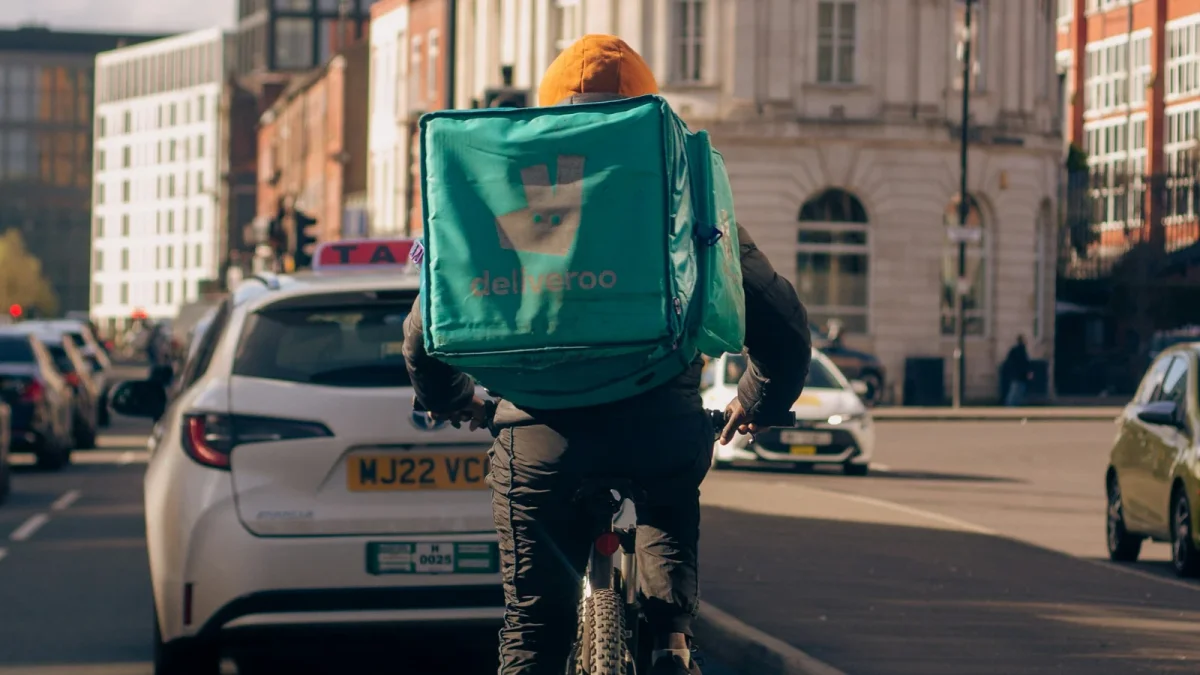
The first thing to know about Deliveroo driver pay is that there is no hourly wage. Every order carries its own fee, you see the full amount before you accept it, and what you earn across a shift is the sum of the orders you complete, minus the costs of the vehicle you did them on.
The second thing is that Deliveroo publishes more about its pay than most food platforms, because of its agreement with the GMB union. There is a guaranteed floor per hour of estimated on-order time, reviewed every April. That floor is the anchor for everything below. What it is not is a guarantee for the hour you spend logged in, and the gap between the two is where most of the confusion about Deliveroo earnings comes from.
How Deliveroo pay works: a fee per order, shown before you accept
When an order comes through, the rider app shows the collection point, the delivery address, and the full fee you will be paid if you complete it. Stacked orders show every pickup and every customer on the map. You can reject any offer for any reason, and Deliveroo's own rider site says that rejections have no effect on the orders or fees you are offered later.
According to Deliveroo's fees page, each fee is unique and based primarily on the road distance and the time it estimates the order will take. There is no fixed collection fee, drop-off fee or per-mile rate. The factors that move the number are:
- Where you are when the offer arrives, and where the collection and delivery are.
- How long Deliveroo estimates the pickup and delivery will take.
- The time of day and day of the week. Fees are higher at busier times.
- How busy the restaurant or shop is.
- Whether a boost is running in your zone.
- The vehicle you are registered on. Fees are slightly higher for cars and scooters, because the fee includes an allowance for the higher cost of running them.
Things that do not move the fee: how many orders you have rejected, how long you have been riding, how fast you completed past orders, or whether you use a substitute. Fees are paid only for completed orders. Cancel after accepting, or fail to deliver, and nothing is paid for that order.
The pay floor: what Deliveroo guarantees per hour on an order
Deliveroo has a voluntary partnership agreement with the GMB union, signed in 2022, and part of it is a pay floor renegotiated each year. The floor works like this: for the time Deliveroo estimates an order will take, from the moment you accept it to the moment you mark it delivered, the fee must reach a minimum hourly rate.
For the 2026 to 2027 year, effective 1 April 2026, the minimums per hour of estimated on-order time are:
| Vehicle | Minimum per hour on an order | 20-minute order pays at least |
|---|---|---|
| Car | £17.18 | £5.73 |
| Scooter | £14.40 | £4.80 |
| E-bike | £12.99 | £4.33 |
| Bike | £12.88 | £4.29 |
The car figure and the £5.73 example are Deliveroo's own; the other three worked examples are that arithmetic applied to Deliveroo's published rates. The figures are inclusive of vehicle costs, which is why the car rate is a third higher than the bike rate: the difference is meant to cover fuel and insurance, not to pay a car driver more for the same work.
Three things the floor does not do, and they matter more than the headline number:
- It covers estimated time, not actual time. Deliveroo says its estimates are built from millions of real journeys and are accurate on average. On an individual order, a long wait at the restaurant or a traffic jam can take longer than the estimate, and the fee does not move.
- It covers on-order time only. The minutes between marking one order delivered and accepting the next are unpaid. In a quiet zone on a Tuesday afternoon those minutes can be most of the hour.
- It is not a wage. The bike floor sits a few pence above the National Living Wage of £12.71, but the two are not comparable. The floor is revenue for a self-employed rider, before costs and before tax, and the Supreme Court confirmed in November 2023 that Deliveroo riders are not workers, so no minimum wage law applies to them.
What riders actually gross per hour
Because waiting time is unpaid, what a rider grosses per logged-in hour depends almost entirely on how many of those 60 minutes are spent on an order. The floor makes the arithmetic honest:
| Minutes on an order per logged-in hour | Bike (floor £12.88) | Car (floor £17.18) |
|---|---|---|
| 30 minutes | £6.44 | £8.59 |
| 40 minutes | £8.59 | £11.45 |
| 50 minutes | £10.73 | £14.32 |
| 55 minutes | £11.81 | £15.75 |
Those are minimums at the floor, before boosts and tips. Fees above the floor at busy times push the real figure higher; a dinner peak in a dense city zone routinely delivers back-to-back orders, and that is where the better hours come from.
Across courier community and aggregator reporting, active delivery time on Deliveroo indicatively works out at £8 to £14 an hour gross. Deliveroo does not publish an average, so treat that band as indicative rather than official. Over a 35-hour week it comes to roughly £280 to £490 before anything comes out, the same range our comparison of which delivery company pays most uses. A rider working only Friday and Saturday evenings will sit at the top of the band per hour and a rider spreading 35 hours across weekday afternoons will not.
What comes out: costs by vehicle
The gross figure is not the number that matters. What you keep depends on what you ride.
Bicycle and e-bike
The cheapest way to ride. No fuel, no hire and reward premium, no congestion charge. Deliveroo provides two kinds of free cover to every rider: personal injury and income protection while you are on an order and for 15 minutes after it, and public liability, which for cyclists applies the whole time you are logged in. Your own costs are the bike, a thermal bag, a lock, tyres and brakes, a power bank and waterproofs. A cyclist in a busy zone keeps most of what the table above shows.
Scooter or motorbike
Deliveroo's insurance page says that for cars and motorised scooters you need both standard Social, Domestic and Pleasure cover and Hire and Reward cover (sold as hire and reward, fast food delivery, or carriage of goods for hire and reward), and it wants to see proof before you start. A moped or scooter on food delivery typically costs £400 to £900 a year to insure on an annual policy. Deliveroo names Zego, whose pay-as-you-go cover is integrated with the rider app so you pay only for time online, along with TradeX and Acorn. Fuel is small on a scooter but not zero, and the higher scooter floor exists precisely because these costs are yours.
Car
The most expensive vehicle to run and the one with the highest floor for that reason. Hire and reward cover for a car runs £800 to £1,500 a year, which is about £3 to £6 off every working day before you have moved, and fuel on a busy evening is another £12 to £20. Deliveroo's free public liability cover applies to car and scooter riders only when you are out of the vehicle walking to a pickup or a door; on the road, your own policy is what covers you.
Tax
You are self-employed, so you register with HMRC and file self-assessment, paying income tax and Class 4 National Insurance on your profit. HMRC's simplified mileage rate for the 2026 to 2027 tax year is 55p a mile for the first 10,000 business miles in a car and 25p after that, and 24p a mile on a scooter or motorbike. Insurance premiums, your bag and kit, and the work share of your phone bill are all deductible. Set a share of every payout aside from the first week.
On our estimates, a car driver doing 35 hours a week nets roughly £215 to £455 after fuel and insurance but before tax. A cyclist doing the same hours keeps close to the gross figure.
When and how you get paid
Deliveroo pays fees every Tuesday, covering orders completed from Monday to Sunday the previous week, by bank transfer.
If you want the money sooner, the cash out feature on the Earnings page of the rider app releases your current balance on demand. Request it before 5.30pm Monday to Friday and Deliveroo says the payment is instant; after that, or at the weekend, it lands the next working day. Each cash out costs 50p, shown on your invoice as a transaction fee. Occasionally the feature is unavailable, in which case the Tuesday payment runs as normal.
Tips are separate from fees. Customers can tip in the app before or after delivery, riders keep 100%, and tips are paid at the same time as fees. Deliveroo asks riders not to prompt customers for a tip at the door.
One structural note for anyone reading older guides: DoorDash completed its acquisition of Deliveroo in October 2025. The rider app, the fee model and the GMB floor continued unchanged, and Deliveroo still publishes its UK rider terms itself.
How to earn more on Deliveroo
- Ride the peaks. Lunch, roughly 12pm to 2pm, and dinner, roughly 6pm to 10pm. Friday and Saturday evenings are the busiest and carry the highest fees. Rain and cold push order volume up too.
- Work a dense zone. More restaurants per square mile means shorter gaps between orders, which is the single biggest driver of your effective hourly rate.
- Use boosts and challenges. Deliveroo runs zone-level fee boosts and completion challenges at busy times; the app lists what is live in your area.
- Reject the orders that do not pay. Deliveroo says rejections do not affect future offers or fees, so a long, low-fee order with a known slow restaurant costs you nothing to decline.
- Run a second app. Deliveroo does not require exclusivity. Most experienced riders hold Just Eat or Uber Eats accounts too and take whichever order lands first, which smooths out the quiet stretches on any one platform.
- Match the vehicle to the zone. In a tight city centre a bike or e-bike is as fast as a scooter and far cheaper to run. In a spread-out suburb a scooter covers the ground.
Deliveroo pay compared with Just Eat, Uber Eats and Amazon Flex
| Deliveroo | Just Eat | Uber Eats | Amazon Flex | |
|---|---|---|---|---|
| Pay structure | Per order, fee shown upfront | Per delivery (transit pay) | Per delivery, plus distance and time | Per block, rate shown upfront |
| Published floor | GMB floor per hour on an order | None (employed option exists) | None | Block rate fixed before you accept |
| Indicative gross per hour | £8 to £14 | £8 to £13 | £9 to £15 | £14 to £18 |
| Pay day | Weekly, Tuesday, plus 50p cash out | Weekly | Weekly | Weekly |
| Tips | Yes, 100% | Yes | Yes, 100% | Rare in the UK |
| Minimum vehicle | Bicycle | Bicycle | Bicycle | Car (e-bike on Amazon Now) |
The floor is Deliveroo's distinctive feature: neither Just Eat nor Uber Eats publishes an equivalent. It does not make Deliveroo the highest-paying app in every city, because density and boosts still decide the real figure, but it does make a low-fee order easier to spot. For the detail on the others, see how much Just Eat drivers make, what driving for Uber Eats pays and our guide to how Amazon Flex works in the UK.
Frequently asked questions
How much does a Deliveroo driver make per hour?
Indicatively £8 to £14 an hour of active riding, before costs, based on courier community and aggregator reporting. Deliveroo itself only guarantees a floor for the time it estimates an order takes: from 1 April 2026 that is £12.88 an hour on a bike, £12.99 on an e-bike, £14.40 on a scooter and £17.18 in a car, inclusive of vehicle costs. Time waiting between orders is unpaid, which is why a logged-in hour usually grosses less than the floor.
How much does Deliveroo pay per delivery?
There is no fixed fee. Each order carries its own fee, shown in full on the offer screen before you accept, based mainly on the road distance and time Deliveroo estimates for it, plus the time of day, how busy the restaurant is, any boosts and the vehicle you ride. The GMB pay floor sets the minimum: a 20-minute order in a car pays at least £5.73, and the same order on a bike at least £4.29.
Do Deliveroo riders get paid weekly?
Yes. Fees for orders completed Monday to Sunday are paid every Tuesday by bank transfer. If you want the money sooner you can cash out from the Earnings page in the rider app for a 50p fee: before 5.30pm on a weekday the payment is instant, otherwise it arrives the next working day.
Does Deliveroo pay minimum wage?
No, because Deliveroo riders are self-employed, which the Supreme Court confirmed in November 2023, so the National Living Wage of £12.71 an hour does not apply. What exists instead is the pay floor agreed with the GMB union, which guarantees a minimum fee per hour of estimated on-order time and is reviewed every year. It does not cover the time you spend waiting for the next order.
Do Deliveroo pay for petrol?
No. Fuel, insurance, maintenance and your phone are your costs as a self-employed rider. You can claim them against tax: HMRC's simplified mileage rate for the 2026 to 2027 tax year is 55p a mile for the first 10,000 business miles in a car and 25p after that, and 24p a mile on a scooter or motorbike. Keep a mileage log from your first order.
Do Deliveroo riders keep their tips?
Yes. Customers can tip in the app before or after delivery, riders keep 100% of it, and tips are paid out with the weekly fees. Deliveroo asks riders not to prompt customers for a tip at the door.
The short version
Deliveroo pays per order, weekly, with a published floor for on-order time and nothing for the minutes in between. A cyclist in a dense zone working dinner peaks keeps most of a decent hourly figure; a car driver in a quiet suburb carries an insurance bill the floor was only ever partly designed to cover. If you have not signed up yet, our guide to becoming a Deliveroo rider covers the documents, the insurance check and the kit, and the form below takes a minute if you want to see who else is hiring near you.