
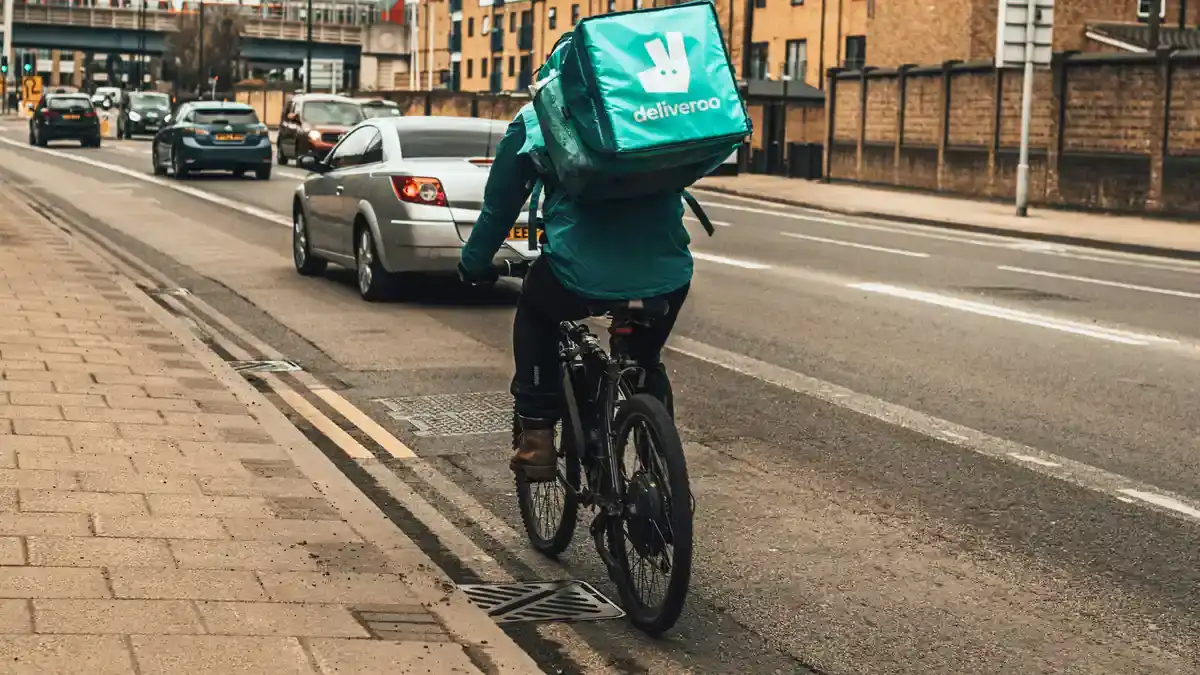
Deliveroo recruits riders across the UK, including London, Manchester, Birmingham, Leeds, Cardiff and Glasgow. If you are 18 or over, have the right to work here as self-employed, and have a bicycle, scooter or car, you can apply directly through the rider site.
This guide covers the practical side: who qualifies, the insurance that catches most applicants out, how the sign-up actually works, and what the work pays once your costs come out.
What does a Deliveroo rider do?
Deliveroo riders collect orders from restaurants and shops and deliver them to customers nearby, usually within a mile or three. Most drops take somewhere between 15 and 30 minutes from pick-up to hand-over.
You work as self-employed. There are no guaranteed hours, no set shift pattern and no employer benefits. You log into the app when you want to work and log off when you are finished. You are not obliged to accept every order you are offered.
Deliveroo rider requirements in the UK
Deliveroo publishes its requirements on the rider support site. The list itself is short; the insurance line is the one that stops most applications.
Age. You must be 18 or over. Deliveroo applies this with no exceptions, and it is a higher bar than the law sets for delivery work generally.
Right to work. You need proof of your right to work in the UK as self-employed. Deliveroo verifies this during sign-up through a third-party identity check.
No unspent criminal convictions. This is a stated condition of riding, not a discretionary check.
A smartphone. Deliveroo asks for iOS 17.0 or Android 8 and above, with NFC and a working camera. You also need a data plan, since the app runs throughout your shift.
A UK bank account. Deliveroo pays weekly into a UK account.
Insurance appropriate to your vehicle. For anything motorised this is the real hurdle, and it is covered properly in the next section.
The insurance you actually need
If you ride a bicycle, you need no specialist policy to deliver food. Public liability cover is worth having rather than required, and runs roughly £50 to £200 a year.
If you drive a car or a motorised scooter, Deliveroo requires two things, and it wants proof before you start riding:
- Social, domestic and pleasure cover, which is standard motor insurance for your own everyday use of the vehicle.
- Hire and reward cover, sometimes sold as fast food delivery insurance or carriage of goods for hire and reward. This is what covers you for carrying goods to a third party for payment.
This is the point people get wrong. A standard personal motor policy does not cover commercial delivery work, and delivering on one can invalidate it. Hire and reward sits on top.
Expect roughly £400 to £900 a year for a moped or scooter and £800 to £1,500 a year for a car on food delivery work. Pay-as-you-go policies that charge only for the hours you are logged in are widely used by riders working part time, and some are integrated with the Deliveroo app itself. Our insurance cost guide breaks the bands down by vehicle.
Separately, Deliveroo provides riders with its own free insurance covering certain accident and third-party scenarios while you are working. It does not replace hire and reward, and it does not cover you driving to or from a zone, so read what it includes rather than assuming it fills the gap.
Which vehicles can you use?
Deliveroo accepts four categories.
Bicycle. The lowest barrier to entry: no specialist insurance, no licence, no vehicle costs beyond maintenance. Well suited to compact city-centre zones, where cyclists often match scooter riders on drops per hour because they filter through traffic and park anywhere. E-bikes count here too and widen your radius.
Cargo bicycle. Accepted as its own category, and useful on grocery and larger orders.
Scooter or motorcycle. Faster across the longer distances common in suburban zones. Needs hire and reward cover. Worth knowing that a provisional licence plus CBT is accepted for scooters, so you do not need a full motorcycle licence to start.
Car. Needs a full category B licence and hire and reward cover. More comfortable over distance and in bad weather, less efficient in a dense centre where parking eats your time.
Your vehicle influences which zone Deliveroo assigns you to. Centre zones tend to go to cyclists and scooter riders; car drivers are more often given wider suburban areas.
How to sign up as a Deliveroo rider
- Go to the Deliveroo rider site and create an account.
- Enter your personal details and select the city or zone you want to work in.
- Choose your vehicle type.
- Upload your right-to-work documents for the identity check.
- If you are on a scooter or in a car, upload your driving licence (or provisional plus CBT) and your proof of hire and reward cover.
- Wait for approval. Deliveroo does not publish a guaranteed turnaround, and cases needing manual review take longer than automated ones, so treat any timescale you read elsewhere as a rough guide rather than a commitment.
- Download the rider app, log in, and start accepting orders.
Once you are approved, Deliveroo points you at its kit portal for the branded insulated backpack. The bag is not free. You can use your own thermal bag instead if it meets Deliveroo's minimum standard, which is worth checking before you buy anything.
What Deliveroo riders earn
Deliveroo pays per order, not per hour, and every fee is shown in full before you accept it. Under the pay floor agreed with the GMB union, the fee for the time Deliveroo estimates an order takes must reach at least £12.88 an hour on a bike, £12.99 on an e-bike, £14.40 on a scooter and £17.18 in a car from April 2026, inclusive of vehicle costs. Time waiting between orders is unpaid, so active riding indicatively works out at £8 to £14 an hour before costs, with weekend dinner shifts in a busy city at the top of that range.
Where you ride, when you ride and what you ride on move the figure more than anything else. Our Deliveroo driver pay guide covers the fee model, the floor, what each vehicle costs to run, cash out and tips in detail. For how Deliveroo compares against every other food platform in the UK, see our guide to the best food delivery jobs.
Equipment worth having before your first shift
- A thermal bag. Required, whether it is Deliveroo's or your own.
- A phone mount. Cheap, and essential for hands-free navigation on a bike or scooter.
- A power bank. A 10,000 to 20,000 mAh battery covers a full day of app use and navigation.
- Proper waterproofs. A jacket and trousers that go on and off quickly. UK weather makes this non-negotiable, and it is the thing new riders most often skip and then regret.
Tax and self-employment
Deliveroo riders are self-employed, so you register with HMRC and report your earnings through self-assessment, paying income tax and Class 4 National Insurance on your profit.
You deduct work costs from your gross earnings before working out taxable profit. What typically qualifies:
- Mileage. Under HMRC's simplified expenses, cars and goods vehicles are 55p a mile for the first 10,000 business miles and 25p after that, for the 2026 to 2027 tax year. Motorcycles and scooters are 24p a mile.
- Hire and reward premiums.
- The work proportion of your phone and data costs.
- Your delivery bag and equipment.
- Helmets and waterproofs bought for the work.
Keep records from your first shift. The tax year runs April to April, and the online self-assessment deadline is 31 January after it ends.
Deliveroo compared with Just Eat and Uber Eats
| Platform | Vehicles accepted | Pay structure | In-app tipping |
|---|---|---|---|
| Deliveroo | Bicycle, cargo bicycle, scooter, car | Per delivery, distance-weighted | Yes, occasional |
| Just Eat | Bicycle, scooter, car | Per delivery | Not built in |
| Uber Eats | Bicycle, scooter, car | Per delivery, plus distance and time | Yes, consistent |
All three treat couriers as self-employed. None of them impose exclusivity, so you can hold accounts on several and switch based on where the orders are. Running two or three apps at once is legal and completely standard practice.
Worth noting on age: Deliveroo and Just Eat both set 18, but Uber Eats asks for 19 to deliver by car, so a comparison on that point is not quite like for like.
FAQs about becoming a Deliveroo rider
Can you deliver for Deliveroo on a bicycle?
Yes. Bicycles are a fully supported category and need no hire and reward insurance, which makes them the cheapest way to start. In a dense centre, cyclists are often as productive as scooter riders because they get through traffic and park more easily. E-bikes and cargo bicycles are accepted too.
Do you need a full licence to deliver on a scooter?
No. Deliveroo accepts a provisional licence together with CBT for scooter riders. You still need hire and reward insurance on top of your standard cover, and Deliveroo wants proof of it before you start.
Do Deliveroo riders need a thermal bag?
Yes. You need an insulated bag to keep food at temperature. Deliveroo sells its branded backpack through the rider kit portal after you are approved, and it is not free. A third-party thermal bag is fine as long as it meets Deliveroo's minimum standard.
Is delivering for Deliveroo self-employed?
Yes. Deliveroo riders in the UK are self-employed, so you handle your own tax and National Insurance. There is no sick pay, holiday pay or employer pension contribution, and no minimum wage underneath a quiet shift.
Can I ride for Deliveroo and other platforms at the same time?
Yes. Deliveroo does not require exclusivity. Plenty of riders run two or three apps together and take whichever order lands first, which is the main way people smooth out quiet periods on any single platform.
How much can you make in a day with Deliveroo?
It depends almost entirely on when and where you ride. A rider working a Friday dinner peak in a busy city zone will do considerably better per hour than the same rider on a Tuesday afternoon in a low-density area. Plan around the lunch and dinner windows rather than total hours logged on, and treat the result as revenue with costs still to come out.
Before your first order
Sort the insurance before the sign-up, not after, and buy the waterproofs before the first wet Friday. If you are still weighing up the work itself rather than the platform, start with our complete guide to becoming a delivery driver in the UK. If you want to see who else is hiring riders near you, the form below takes a minute.