
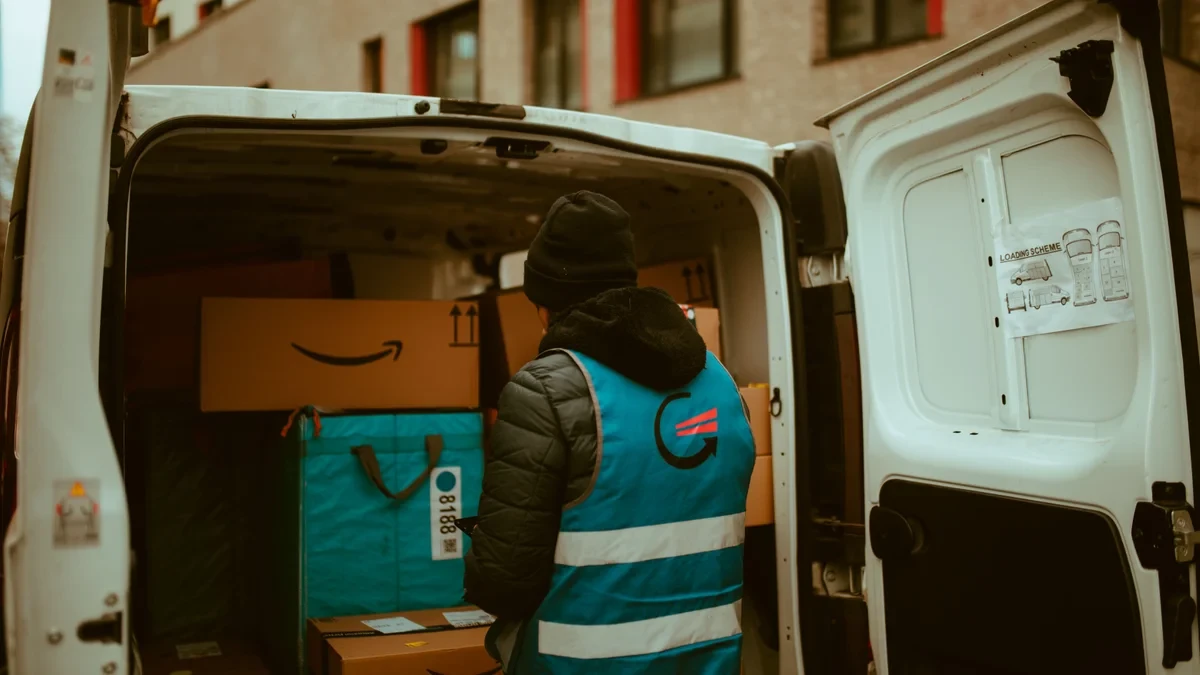
There are two Amazon delivery driver jobs in the UK, and they have almost nothing in common beyond the parcels. Amazon Flex is self-employed: you book blocks in an app and deliver in your own car, or on an e-bike for local orders. A delivery service partner, or DSP, role is employed: you drive a partner company's Amazon-branded van on a planned route of nine to ten hours, on a day rate, with holiday pay and a pension.
Most guides braid the two together, and several mix in American requirements that do not apply here. This one keeps them apart. It covers what each asks for, what each pays, what comes out of that pay, and how to apply, so you can pick the one that fits how you want to work. If you are new to delivery driving in the UK altogether, that guide covers the documents and HMRC steps that come first.
Two ways to deliver for Amazon in the UK
Amazon Flex. You are a self-employed delivery partner. You reserve delivery blocks in the Flex app, collect parcels from an Amazon delivery station or a grocery site, deliver them in your own vehicle, and are paid per block. You choose when to work by choosing which blocks to take. You arrange your own insurance, pay your own fuel, and file self-assessment with HMRC.
Delivery service partner driver. You are employed by an independent company that holds a contract with Amazon to run vans out of a delivery station. The partner recruits you, pays you, provides the van, the fuel and the insurance, and gives you a route. Partner listings advertise the roles as employed, with paid holiday and a pension, and the partner sets the wages and benefits, not Amazon. If you would rather run one of those companies yourself, our guide to becoming an Amazon DSP owner covers what Amazon asks for.
The rest of this guide takes each in turn.
Amazon Flex UK: blocks, pay and requirements
How blocks work
A block is a scheduled window with a start time, a pickup location, a delivery area and an estimated earnings figure shown before you accept it. Flex's UK site describes three kinds: standard parcel blocks from an Amazon delivery station of up to five hours, grocery blocks from an Amazon Fresh site of up to two hours, and Amazon Now local blocks of up to four hours, which are the ones open to e-bikes. You take the blocks you want; in busy areas the popular ones book out in seconds, and in rural areas there are fewer of them.
What Flex pays
Amazon Flex's own UK site says "most drivers earn up to £14 to £18 per hour" for blocks completed in a standard vehicle, with a disclaimer that the actual figure depends on time per stop and traffic. That is a company-published figure, which is rarer than it should be in this industry, and it is a ceiling rather than a wage. It is also revenue. For the block types, the sign-up steps and the full cost picture, our Amazon Flex UK guide goes deeper than this comparison can.
| Amazon Flex | |
|---|---|
| Status | Self-employed |
| Pay | Per block, estimated earnings shown before you accept; most drivers earn up to £14 to £18 an hour according to Amazon |
| Pay frequency | Weekly |
| Vehicle | Your own car, van or, for Amazon Now, e-bike |
| Insurance | Yours to arrange |
| Fuel | Yours |
The single largest cost is insurance. Amazon Flex's UK requirements page lists hire and reward insurance plus at least social, domestic and pleasure cover for car drivers, and names Inshur and Zego as partner insurers offering hourly, monthly and annual policies. Our delivery driver insurance cost guide puts a car on parcel work at £800 to £1,500 a year for an annual policy, roughly £3 to £6 a working day, though a pay-as-you-go hourly policy changes the arithmetic for someone doing two blocks a week. Fuel is yours, and HMRC lets you claim 55p a mile for the first 10,000 business miles in 2026/27 against your tax bill.
Flex requirements
From Amazon Flex's UK requirements page:
- 18 or over
- The legal right to work in the UK, checked during onboarding
- A full UK driving licence for car deliveries
- A mid-size or larger car with five or more seats; vans and enclosed pickups are also accepted
- Hire and reward insurance plus standard cover
- A compatible Android or iPhone smartphone
- A UK bank account for weekly payment
- Living in an area where Flex operates
For Amazon Now deliveries the vehicle can be an e-bike instead: battery-assisted, meeting EAPC standards with no unlawful modifications, carrying an insulated bag or cargo box of at least 55 by 26 by 36 centimetres that holds 15kg, with public liability and personal accident insurance, a helmet and a high-visibility vest. No driving licence is needed for the e-bike route. Our guide to bike delivery jobs in the UK covers what that costs a rider.
Amazon DSP UK: an employed round in a partner's van
What the job is
A DSP driver's day is a multi-drop parcel round. You arrive at the Amazon delivery station at your slot, load a pre-sorted van, and work a planned route of nine to ten hours until it is done. The van, fuel, insurance and handheld are the partner's. Listings describe the role as physically demanding, and they mean it: a full route is well over a hundred stops, each one in and out of the driver's seat with a parcel. Our guide to multi-drop delivery covers the habits that turn a six o'clock finish into a three o'clock one.
What a DSP pays
Delivery service partners mostly advertise a day rate. Current adverts run £145 to £180 for a nine to ten hour route, and Indeed puts the average for the role at about £151. Because most of these are employed roles, the National Living Wage of £12.71 an hour at 21 and over sits underneath them: £145 for ten hours is £14.50 an hour, and at the top of the range and the shorter shift it is £20.
| DSP driver | |
|---|---|
| Status | Employed by the partner, not Amazon |
| Pay | Day rate, typically £145 to £180 for a nine to ten hour route |
| Holiday and pension | Yes, as an employee |
| Vehicle | Partner's Amazon-branded van, fuel and insurance included |
| Hours | Planned route, usually four or five days a week, early starts |
One caveat that matters. Some partners and the agencies that recruit for them offer a self-employed version of the same route: a day rate with a weekly van rental deducted, no holiday pay and no floor. On a rented van at five days and ten hours that arithmetic can land a little under the National Living Wage, which is legal because the work is self-employed and is exactly why the offer needs reading twice. Our DPD driver salary guide shows how to cost a self-employed route properly, and the same method applies here.
DSP requirements
Partners set their own, so read the listing, but they consistently ask for:
- A full UK driving licence, usually held for a year or more, with a points limit
- The right to work in the UK
- A background check before your first route
- Physical fitness for a full day of lifting and walking
- Availability for early starts and weekend days
No experience is required: the partner trains you at an in-person session before your first route, and a standard category B licence covers the 3.5 tonne vans.
Flex or a DSP: which one fits
| Amazon Flex | DSP driver | |
|---|---|---|
| Who you work for | Yourself | The partner company |
| Hours | The blocks you choose | The routes you are given |
| Pay | Per block, up to £14 to £18 an hour before costs | Day rate, £145 to £180 advertised |
| Quiet week | Fewer blocks, less money | The same pay |
| Vehicle and insurance | Yours | Theirs |
| Holiday pay and pension | No | Yes |
| Best for | Fitting work around something else | A full-time round with a payslip |
Flex is the right answer if you want to choose your hours and already own a suitable car, and the wrong answer if you need the same money every month. A DSP round is the right answer if you want a full week of driving with the van paid for, and the wrong answer if you cannot do 7am starts and ten-hour days. Neither is a compromise version of the other.
Other Amazon driving jobs
One more category exists, and it is a different job: Amazon and its haulage contractors advertise HGV trunking between fulfilment centres and delivery stations, often at night, on a Class 1 or Class 2 licence with a Driver CPC. Our HGV driver salary guide covers what that pays and asks for.
How to apply
For Flex. Download the Amazon Flex app, create an account, and go through the onboarding checks: identity, right to work, licence and insurance documents. Once approved you see the block calendar for your area and reserve your first one. In busy areas the wait is usually for a block rather than for approval.
For a DSP role. Partner vacancies appear on Indeed and the other job boards under the partner's name with "Amazon" in the description, and Amazon's UK logistics site links through to delivery associate roles at its partners. Apply to the partner, not to Amazon: the interview, the training session and the payslip are all theirs. Have your licence, a DVLA check code, proof of right to work and your National Insurance number ready, because that is where applications stall.
If you are reading this from the United States, the requirements, the pay and the vehicle rules are all different there, and our US guide to Amazon Flex against DoorDash covers that market.
Frequently asked questions
How much do Amazon delivery drivers earn in the UK?
It depends which of the two jobs you mean. Amazon Flex's own UK site says most drivers earn up to £14 to £18 an hour for booked blocks, before fuel, insurance and tax, because Flex drivers are self-employed. Delivery service partner drivers are employed and mostly paid a day rate: adverts run £145 to £180 for a nine to ten hour route, and Indeed puts the average at about £151. The National Living Wage of £12.71 an hour applies to the employed roles and not to Flex. Our comparison of the best delivery driver jobs sets Flex against Evri and DPD.
What do you need to drive for Amazon Flex in the UK?
Amazon Flex's UK requirements page asks for: 18 or over, the right to work in the UK, a full UK driving licence, a mid-size or larger car with five or more seats (vans and enclosed pickups are also accepted), hire and reward insurance on top of your standard cover, a compatible smartphone and a UK bank account. For Amazon Now local deliveries an e-bike meeting EAPC standards is accepted instead, with no licence needed but public liability and personal accident insurance required.
Is an Amazon DSP driver employed by Amazon?
No. Delivery service partners are independent companies that run Amazon-branded vans out of Amazon delivery stations, and the partner employs you, sets your pay and manages your performance. Partner listings say the partner provides the van, fuel and insurance and that drivers are employees with paid holiday and a pension. Some partners and agencies also offer self-employed day rates with a van rental, which is a different deal.
Does Amazon Flex provide insurance?
Not according to Amazon Flex's current UK requirements page, which lists hire and reward insurance plus standard cover as something the driver must hold, and names Inshur and Zego as partner insurers. E-bike riders on Amazon Now must hold public liability and personal accident cover. Older guides describe Amazon covering drivers during blocks, so check the requirements page rather than a forum before you budget. The insurance cost guide has the figures.
Do I need a van for an Amazon delivery job?
Not for Flex: a mid-size car with five seats is the standard vehicle, and vans are accepted but not required. Not for a DSP role either, because the partner provides the van. The only Amazon driving work that needs your own van is a self-employed day-rate arrangement with a van rental, and a standard category B licence covers the 3.5 tonne vans used on every one of these rounds.
Pick the job, then read the offer
Flex if you want to choose your hours and can carry the insurance; a DSP round if you want a full week with the van paid for. Whichever it is, read the pay as revenue or as a wage depending on which side of that line you are on, and if a day rate comes with a van rental attached, cost it before you sign. To see Amazon next to Evri, DPD and the supermarkets, the best delivery driver jobs comparison does that. If you want to see who is hiring near you, the form below takes a minute.