
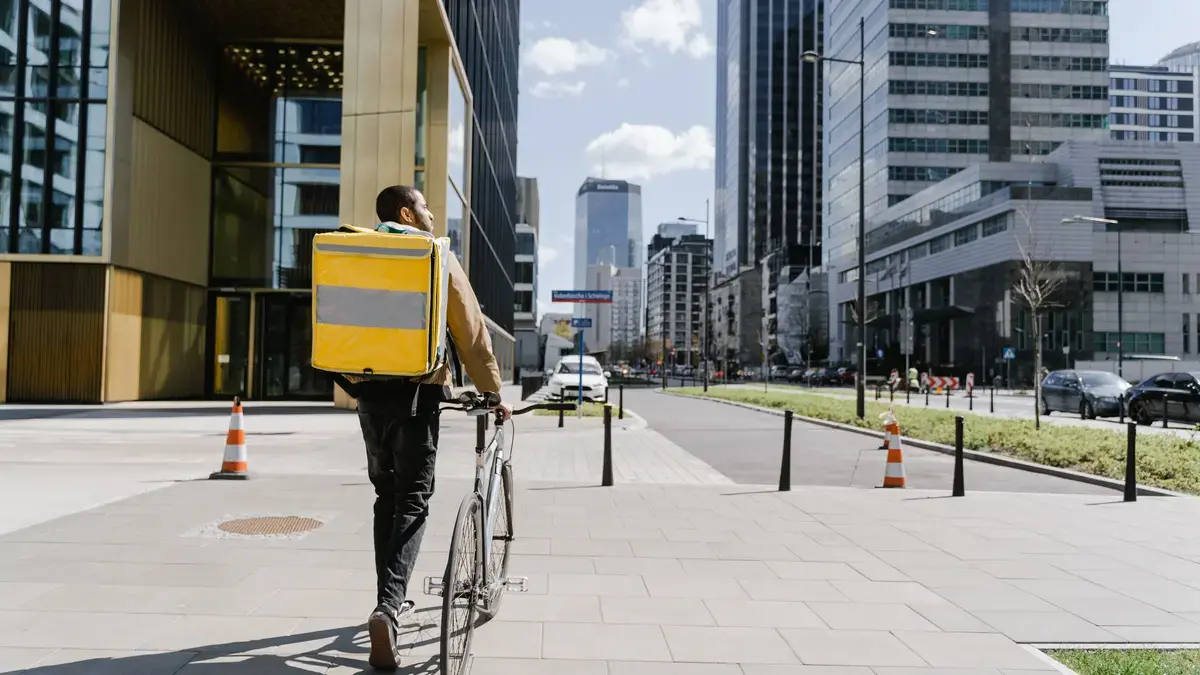
Bike delivery jobs are the cheapest way into delivery work in the UK, and in a dense city centre they are often the best paid per hour as well. No fuel, no hire and reward insurance, no licence, and a courier on two wheels filters past the queue of mopeds and parks at the door. If you already own a bike and live somewhere with a takeaway strip, you can be earning within a week.
What the app adverts skip is the cyclist's side of the ledger: what a winter of wet riding does to a chain, how far an e-bike battery actually gets you on a Friday night, which platforms will take a cargo bike, and the fact that every figure below is revenue rather than a wage. This guide covers both halves.
Which apps take cyclists
Five platforms in the UK take couriers on two wheels, and they do not all take the same two wheels.
Just Eat. Bicycle, moped and car. A bike courier needs only government photo ID and a smartphone, according to Just Eat's own courier help centre, and no vehicle insurance or registration. Bike delivery is not switched on in every zone, so check your postcode before you apply. Just Eat asks for 18 or over.
Deliveroo. Bicycle, cargo bicycle, scooter and car, each as its own category. You need to be 18, hold a UK bank account, prove your right to work self-employed in the UK, and carry a phone with NFC and two cameras. Deliveroo's rider site lists a helmet, reflective jacket, phone mount and insulated backpack as the core kit for a cyclist. Our Deliveroo rider guide walks through the application.
Uber Eats. Bicycle, moped and car. Uber's help centre asks a cyclist for photo ID and a minimum age of 18; the age rises to 19 for delivering by car. Uber Eats has the most consistent in-app tipping of the four food apps, and takes a service charge of 20% to 25% on delivery fees.
Stuart. Bicycle, cargo bike, e-bike and motorised vehicles, with the mix depending on the city. Stuart's own pages say that outside London and Manchester its bicycle deliveries are capped at 12kg and 80 litres, which tells you something about the kind of order a bike gets. Stuart mixes retail and business deliveries with restaurant work, so the runs are longer and more scheduled than a dinner rush.
Amazon Flex. Not takeaway work, but since Amazon opened its "Amazon Now" local deliveries to e-bikes it belongs on this list. Flex's UK requirements page accepts a battery-assisted e-bike meeting EAPC standards, no driving licence, 18 or over, blocks of up to four hours, and it requires a cargo box or insulated bag of at least 55 by 26 by 36 centimetres that holds 15kg, plus public liability and personal accident insurance. A standard pedal bicycle is not accepted.
| Platform | Two wheels accepted | Minimum age | Tips |
|---|---|---|---|
| Just Eat | Bicycle, e-bike, moped | 18 | In-app tipping |
| Deliveroo | Bicycle, e-bike, cargo bike, scooter | 18 | Occasional in-app tips |
| Uber Eats | Bicycle, e-bike, moped | 18 on a bicycle, 19 by car | Consistent in-app tips |
| Stuart | Bicycle, e-bike, cargo bike | Not published | No in-app tipping |
| Amazon Flex (Amazon Now) | E-bike only | 18 | No tipping |
What bike delivery jobs pay
Every food app pays per delivery, not per hour. The figures below are what an hour of active riding indicatively produces before costs, drawn from our food delivery platform comparison and sourced from aggregators and courier communities rather than from the platforms, which publish no rate.
| Platform | Indicative revenue per active hour |
|---|---|
| Just Eat | £8 to £13 |
| Deliveroo | £8 to £14 |
| Uber Eats | £9 to £15 |
| Stuart | £10 to £16 |
For a cyclist the costs that come out are small, which is the whole case for the bike: no fuel, no motor insurance, no MOT. What does come out is the bike's own wear, which the winter section below puts a shape on, and your tax reserve.
Two things move a cyclist up or down that table more than the choice of app. The first is density: in a city centre where the restaurants and the customers are within a mile of each other, a cyclist can complete three or four drops an hour and beats a moped stuck at the lights. In a spread-out town where every order is a two-mile ride each way, the same courier does half that and the bottom of the band is optimistic. The second is timing: Friday and Saturday dinner peaks pay the most per hour on every app, and a wet weeknight in February pays what the orders pay, which can be almost nothing. Cyclists who make it work run two apps at once and log off when both go quiet.
On tips, Uber Eats' consistent in-app tipping is a real supplement in a big city; Just Eat has in-app tipping too; Deliveroo's is occasional; Stuart has none. None of them is a plan.
What it costs a cyclist
The car guides on this blog spend a whole section on insurance because a car driver's hire and reward policy runs £800 to £1,500 a year. A cyclist's list is shorter.
Public liability insurance: £50 to £200 a year. Not required by law, not required by Just Eat, Deliveroo or Uber Eats, and worth having anyway. It covers you if you knock a pedestrian over or scratch a car while working. Amazon Flex requires it for e-bike riders, along with personal accident cover.
The bag. Every platform expects an insulated backpack or box. Deliveroo and Just Eat sell branded kit; a plain thermal backpack works on the others. Budget for a second inner bag liner, because pizza boxes and curry leak.
A phone mount, a power bank and a good lock. The app runs your whole shift, the screen drains a battery in four hours of navigation, and a courier bike gets stolen from outside a restaurant more often than any other bike in the city.
Lights and a helmet. Front and rear lights are a legal requirement after dark, and most of the money in this job is earned after dark from October to March.
Tax. You are self-employed, so you register with HMRC and file self-assessment. HMRC's simplified mileage rates cover cars, vans and motorcycles, not bicycles, so a cyclist claims the actual costs of the work instead: the bike if you bought it for the job, parts, repairs, the bag, the lights, and the work share of your phone bill. Keep the receipts from the first shift. Our guide to becoming a delivery driver in the UK covers the HMRC registration.
E-bikes: range, charging and the law
An e-bike changes the job more than any other single purchase. It widens the radius you can take orders in, flattens the hills, and lets you ride a fourth hour at the same pace as the first. Every platform above accepts one, and Amazon Flex accepts nothing else on two wheels.
The legal line first. In Great Britain a legal e-bike is an electrically assisted pedal cycle, an EAPC: a motor of 250 watts or less that stops assisting at 15.5 mph, ridden by someone 14 or over, with no licence, registration or insurance required, according to gov.uk. Anything faster or more powerful is legally a moped, which means registration, insurance and a licence. The platforms know this: Amazon Flex's e-bike requirements state "no unlawful modifications", and a courier caught on a derestricted bike is riding an uninsured motor vehicle.
Range is a shift, not a spec sheet. Manufacturers quote range on flat ground with a light rider and gentle assist. A courier rides stop-start, fully loaded, with the assist high because time is money. Expect well under the box figure. In practice the question is whether one battery covers a dinner peak from 5pm to 9pm, and for most mid-range bikes on a hilly city the answer is only just. Couriers who ride full days carry a second battery or charge between the lunch and dinner peaks, and pick a restaurant with a socket near the door as their waiting spot.
Charging is planning. A full charge is typically several hours, so a flat battery at 7pm on a Friday is a lost evening. Charge to full before every peak, carry the charger on long days, and never leave a battery in a cold bike overnight if you can bring it indoors: lithium cells lose usable capacity in the cold, which is exactly when the orders come.
Weight matters when the battery dies. An e-bike is heavier than a road bike by a wide margin, and pedalling one home unassisted with a loaded bag is the moment most couriers decide on the spare battery.
Winter: the kit, and what wet riding does to a drivetrain
Demand peaks in the months the riding is worst. A courier who rides through January earns more per hour than one who rides in June, and pays for it in parts.
What wet roads do to the bike. Rain lifts grit off the road and the rear wheel sprays it straight into the chain, cassette and rear brake. A chain ridden wet and left dirty stretches fast; a stretched chain then wears the cassette and chainring to match it, so a neglected £20 chain becomes a £100 drivetrain by spring. Rim brake pads that would last a summer wear down in weeks of gritty water, and disc pads go too, just slower. The fixes are boring and they work: rinse the drivetrain after a wet shift, wipe it dry, re-lubricate with a wet-weather lube, and replace the chain when a chain checker says so rather than when it starts skipping. Full-length mudguards are the single best-value winter part on a courier bike, because they keep most of that spray off the chain and off your back.
Hub gears and belt drives exist for exactly this reason. A courier bike with an enclosed hub gear and a belt instead of a chain costs more up front and shrugs off a winter. Many full-time cyclists switch to one after their first spring cassette bill.
Kit that earns its keep. Waterproof overshoes or winter boots, because wet feet end a shift early. A waterproof shell with a hood that fits under the helmet. Two pairs of gloves, one drying while one is on. Clear glasses for spray at night. A cheap second set of lights as a backup, because the first set will fail on the darkest evening of the year. None of this is optional if you intend to ride the December peak, and December is where the money is.
Cargo bikes: who accepts them
A cargo bike turns a food courier into a grocery and parcel courier, and the platforms are slowly catching up.
Deliveroo lists the cargo bicycle as its own vehicle category, and it is useful on the grocery and larger restaurant orders that a backpack cannot take.
Stuart runs bicycles, cargo bikes and e-bikes and describes cargo bikes as part of its city network, which fits its mix of retail and business deliveries.
Amazon Flex does not name cargo bikes, but its e-bike requirement for Amazon Now, a secured cargo box or bag of at least 55 by 26 by 36 centimetres holding 15kg, is easier to meet on an electric cargo bike than on a standard e-bike with a rack.
Just Eat and Uber Eats publish no cargo bike category. A courier signs up as a bicycle and rides what they ride; neither platform's help centre says a cargo bike is refused, and neither says it is welcomed. Ask in your zone before buying one on the strength of either.
The case for a cargo bike is bigger orders and multi-order stacking, and the case against is cost, weight and the fact that most restaurant orders still fit in a backpack. It is the right tool for a courier moving toward grocery and parcel work, not the first bike to buy.
Frequently asked questions
Is being a bike courier worth it?
In a dense city centre, yes: it is the cheapest way into delivery work, with no hire and reward insurance, no fuel and no licence, and cyclists often match moped riders on drops per hour because they filter through traffic and park at the door. It is worth less in a spread-out town where every order is a two-mile ride each way, and it is self-employed revenue with no floor under a quiet shift, so work the dinner peaks and treat the rest as optional. We set out the wider trade in are delivery driver jobs worth it.
Can I use a motorbike to make deliveries?
Yes. Just Eat, Deliveroo, Uber Eats and Stuart all accept mopeds and motorcycles, and Deliveroo accepts a provisional licence with CBT for a scooter. The cost changes though: a motorised vehicle needs hire and reward insurance at £400 to £900 a year for a moped, and Uber Eats requires you to be 19 rather than 18 to deliver by car, so check the age rule for a scooter in the app before you apply. A bicycle needs none of that.
How much do bike couriers make?
Indicatively £8 to £16 an hour of active riding depending on the app, the city and the shift: Just Eat £8 to £13, Deliveroo £8 to £14, Uber Eats £9 to £15 and Stuart £10 to £16, all before costs and all aggregator and courier-community sourced. Weekend dinner shifts in a big city sit at the top; a weekday lunch in a small town sits at the bottom. There is no minimum wage underneath any of it. Our comparison of which delivery company pays the most puts the apps side by side.
How do I become a bike courier?
Apply on the platform's own courier page, not through a third party. Just Eat asks a bike courier for government photo ID and a smartphone; Deliveroo asks for right to work documents, a bank account and a phone with NFC; Uber Eats asks for photo ID and that you are 18. Check that bike delivery is switched on in your zone first, because Just Eat and Uber Eats only offer it in some areas. Most cyclists are riding within a week.
Do I need insurance to deliver by bike?
Not by law: a bicycle needs no motor insurance and the food apps do not require a policy from cyclists. Public liability cover, at £50 to £200 a year, protects you if you injure someone or damage property while working and is worth having. Amazon Flex is the exception among the platforms: its e-bike riders must hold public liability and personal accident insurance before they can take a block. The insurance cost guide has the figures by vehicle.
Ride the peaks, look after the chain
Two apps open at once, the Friday and Saturday dinner peaks protected, a rinsed drivetrain after every wet shift and a battery on charge between them: that is most of what separates a cyclist who earns the top of those bands from one who earns the bottom. If you are weighing the bike against a moped or a car, the food delivery platform comparison covers all three. If you want to see which apps are hiring near you, the form below takes a minute.